
Pressure bearing capacity of steel wire braided rubber hose
Time:2023-06-26Page views:1940Steel wire braided rubber hose is a commonly used auxiliary equipment in hydraulic systems, responsible for transporting gases and liquids. It consists of inner and outer rubber layers and steel wire layers, and is depressurized by specialized equipment to connect various hydraulic components of the hydraulic system. It is mainly used for hydraulic power transmission or pressure media such as water, gas, and oil.
The main manufacturing equipment for high-pressure hose assemblies includes rubber stripping machines, electric presses, cutting equipment, etc. The regulation of setting permissions for high pressure is based on the application characteristics of the hose and the system pressure to establish the working pressure of the hose. Each steel wire braided rubber hose has a corresponding basic pressure, and the burst pressure of the hose engineering is 3-4 times the pressure limit it can withstand.
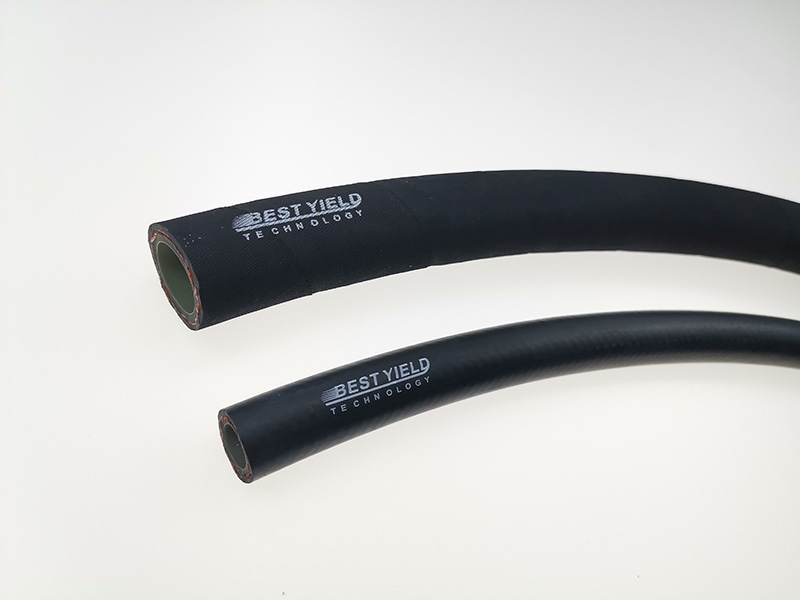
The higher the work pressure, the more layers of steel wire, and the finer the equipment production. Therefore, the working pressure supported by the hose can be selected based on the actual working pressure of the system to ensure its normal operation. If the destructive pressure of the system is frequent, it is necessary to use hoses with relatively high pulse service life, and at the same time, increase knowledge of hydraulic hose specifications and product classification as much as possible.
Steel wire braided rubber hoses have excellent oil resistance, heat resistance, and aging resistance, and are widely used in many fields. The rubber hose has a novel structure and is easy to operate. The reinforced steel wire in the high-strength outer rubber sealing layer and high-strength buffer sealing layer improves the strength of the outer wall of the body and is not easily damaged. In addition to bearing pressure, environmental temperature is also one of the factors that users need to consider when choosing. The natural environmental temperature of hydraulic hoses, whether too high or too low, can damage the service life and load-bearing capacity of the hoses. Therefore, it should be used within its permitted range. For systems where the working temperature is not within its allowable range for a long time, it is advisable to use rubber hoses with corresponding functions.