
The compressive strength and dynamic bending performance of steel wire braided rubber hose
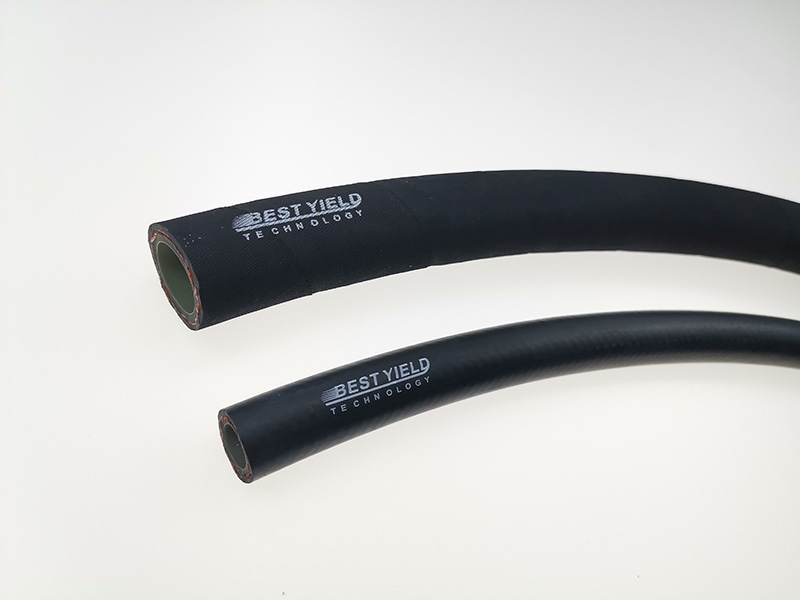
Time:2025-08-28Page views:500As a fluid conveying component in modern industrial fields, the pressure and strength performance of steel wire braided rubber hoses directly determine the safety and reliability of their application scenarios. This type of rubber hose usually consists of an inner rubber layer, a steel wire reinforcement layer, and an outer rubber layer. The steel wire weaving layer serves as the core pressure bearing structure, and a mesh skeleton is formed through precision weaving technology, endowing the rubber hose with excellent compressive strength and dynamic bending performance.
From the perspective of materials science, the pressure bearing capacity of steel wire braided rubber hoses mainly depends on three key factors: the weaving density of the steel wire layer, the diameter of the steel wire, and the material of the steel wire. The rubber hose is woven with high-strength galvanized steel wire, and its single-layer steel wire weaving structure can withstand a working pressure of 21MPa, while the double-layer weaving structure can be increased to 42MPa. The design principle of this hierarchical stacking makes the pressure bearing capacity almost linearly increase. It is worth noting that the weaving angle of the steel wire is usually controlled at a "balance angle" of 54 ° 44 '. This golden angle can ensure both radial compressive strength and axial flexibility, allowing the hose to maintain a stable shape in high-pressure environments.
In practical applications, there are strict standards for the pressure rating classification of steel wire braided rubber hoses. Low pressure products (10-20MPa) are commonly used in hydraulic circuits of construction machinery; Medium pressure type (21-42MPa) is commonly used in industrial equipment such as injection molding machines and die-casting machines; The high-pressure type (over 42MPa) is widely used in harsh working conditions such as oil drilling and mining machinery.
The influence of temperature on the strength of rubber hoses cannot be ignored. When the ambient temperature exceeds 82 ℃, the pressure bearing capacity of the hose will decrease by about 10% for every 15 ℃ increase. Therefore, special synthetic rubber (such as fluororubber) needs to be selected as the lining material for high-temperature conditions. Meanwhile, medium compatibility is also a key factor affecting pressure performance. When transporting petroleum based media such as hydraulic oil and lubricating oil, the inner layer of nitrile rubber performs excellently; When dealing with acidic and alkaline media, special materials such as EPDM or PTFE need to be used.
The impact of installation methods on actual pressure bearing capacity is often underestimated. When the bending radius is less than the recommended value, the outer steel wire of the hose will bear additional tensile stress, resulting in a 30% -50% decrease in pressure bearing capacity. At a working pressure of 42MPa, the minimum bending radius of DN25 rubber hose should not be less than 200mm. At the same time, the mechanical compression at the joint needs to be controlled within a precision range of ± 0.3mm. Excessive compression can cause deformation of the steel wire layer structure and lead to stress concentration.
Pulse pressure testing is the ultimate test to verify the strength of rubber hoses. Qualified high-pressure steel wire braided rubber hoses must undergo at least 200000 pulse tests at a frequency of 15 times per minute under 1.33 times the working pressure. When selecting engineering models, it is necessary to comprehensively consider the relationship between peak pressure and mean pressure. The short-term peak pressure should not exceed 1.25 times the rated working pressure, and the annual cumulative time should be controlled within 50 hours. For systems with water hammer effects, it is recommended to use products with a burst pressure/working pressure ratio of ≥ 4:1 and reserve a safety margin of 15% for pressure fluctuations.